Databricks Fundamentals Certification Training in Gurgaon
Master Databricks Cloud Fundamentals and get prepared for Databricks official certifications with our role based courses tailored to your specific needs.
- Enroll for Architecture, Data Engineering, Developer, Analyst, ML/ AI, Operations, and Governance Certifications
- Experience blended learning through interactive offline and online sessions.
- Job Assured Course


- Course Duration - 2 months
- Get Trained from Industry Experts
Train using realtime course materials using online portals & trainer experience to get a personalized teaching experience.
Active interaction in sessions guided by leading professionals from the industry
Gain professionals insights through leading industry experts across domains
Enhance your career with 42+ in-demand skills and 20+ services
Databricks Fundamentals Certification Overview
This Databricks live-learning courses cover deep into designing, developing, deploying, and managing scalable solutions and infrastructure across Databricks platforms, equipping you for success in today’s fast-evolving technology landscape
- Benefit from ongoing access to all self-paced videos and archived session recordings
- Success Aimers supports you in gaining visibility among leading employers
- Get prepared for 5+ Databricks official certifications with our role based courses tailored to your specific needs
- Engage with real-world capstone projects
- Engage in live virtual classes led by industry experts, complemented by hands-on projects
- Job interview rehearsal sessions

Familiarity with building Data Pipelines, Delta Lake, Unity Catalog, Databricks SQL and Lakehouse fundamentals and building data pipelines for business insights

What is Datbricks Cloud Fundamentals ?
Databricks Certified Lakehouse Fundamentals are essential for driving AI innovation in software development and testing. They manage the full deployment lifecycle—deploying apps, building and maintaining pipelines for web applications and K8s workflows, and automating development and testing processes. By streamlining workflows and resolving challenges in webapp deployment on cloud, and maintenance, they help organizations deliver reliable, high-performance applications faster and more efficiently.
The role of Databricks Cloud Fundamentals?
Databricks Certified Lakehouse Fundamentals in software development and testing oversees the end-to-end lifecycle of web applications, from development to deployment and system performance optimization. Key responsibilities include:
Exploring Emerging Technologies: Leveraging Cloud technologies, Cloud networking, and security techniques to enhance efficiency and streamline deployment workflows.
Scalable Data, AI & WebApps Development: Designing and implementing web applications that address critical business needs.
Seamless Deployment: Coordinating web deployment with infrastructure management for smooth delivery.
Workflow Optimization: Creating, analyzing, and refining automation scripts and deployment workflows to maximize productivity.
For professionals aspiring to excel in this field, the Success Aimers Databricks certified Lakehouse Fundamentals Course provides hands-on training to master these skills. The program equips you to confidently manage deployment lifecycles, deployment pipelines, automation, and deployment processes, positioning you as a high-impact Databricks Certified Lakehouse Fundamentals in software development and testing.”**
Who should take this Databricks Certified Cloud Lakehouse Fundamentals course?
The Databricks Certified Lakehouse Fundamentals Course is tailored for professionals aiming to accelerate their careers in Cloud, data, and technology-driven sectors. It is particularly valuable for roles including:
Databricks Cloud Team Leaders
Databricks Developers
Databricks Cloud Data Engineers.
Databricks Cloud & Engineers
Databricks Cloud Researchers and Data Engineers
This program equips participants with the skills to lead Data & infrastructure initiatives, implement advanced ETL workflows, and drive innovation in Data development and testing.
What are the prerequisites of Databricks certified Lakehouse Fundamentals Course?
Prerequisites for the Databricks certified Lakehouse Fundamentals Certification Course”
To ensure a seamless learning experience, candidates are expected to have:
Educational Background: An undergraduate degree or high school diploma in a relevant field.
Technical Foundation: Knowledge of IT, software development, or data science fundamentals.
Programming Skills: Basic proficiency in languages such as Python or Scala.
Cloud Familiarity: Experience with cloud platforms like AWS or Microsoft Azure.
Meeting these prerequisites enables learners to effectively grasp advanced Databricks Cloud concepts, including Databricks tool, ETL pipeline workflows, Data deployment, and automation throughout the course.
Kind of Job Placement/Offers after Databricks Certification Course?
- Databricks Certified Cloud Engineer
- Databricks Data Engineer
- Databricks Cloud Solutions Architect
- Databricks Cloud Engineer
- Databricks Cloud Engineer / Databricks Cloud Architect
- Databricks Cloud Engineer
- Databricks Cloud Deployment Engineer
| Training Options | Weekdays (Mon-Fri) | Weekends (Sat-Sun) | Fast Track |
|---|---|---|---|
| Duration of Course | 2 months | 3 months | 15 days |
| Hours / day | 1-2 hours | 2-3 hours | 5 hours |
| Mode of Training | Offline / Online | Offline / Online | Offline / Online |
Databricks Lakehouse Fundamentals Course Overview
This Databricks Cloud Fundamentals Certification training enhances your career after choosing the relevant certification path based on the roles. You can practice with hands-on labs and capstone projects and gain proficiency with Databricks tools. After completion of the course, you can leverage Job assistance services and enhance career prospects.
Fundamentals
Databricks Lakehouse Fundamentals Course
Data Lake Basics
- What is a Data Lake
- Full comparison between Data Warehouse and Data Lake
- Challenges of traditional Data Warehouse approach
- How Data Lakes solves these challenges
- Limitations of Data Lakes
Data Lake Architecture
- Data Lake Architecture components overview
- Data Sources
- Data Ingestion Layer
- Data Storage Layer
- Metadata management and Cataloging
- Data Processing and Analytics Layer
- Data Governance and Security
- Data Presentation Layer
- Monitoring and Management
Evaluating Data Lake Fit
- Questions to ask to evaluate Data Lake fit
- Challenges to keep in mind
Implementing Data Lake
- Step 1 -Defining objectives and use cases
- Step 2 - Stakeholder Buy-In
- Step 3 - Build a Cross-Functional Team
- Step 4 - Assess the data sources and specifics
- Step 5 - Choose a Data Lake Platform and Architecture
- Step 6 - Design Data Governance and Security Policies
- Step 7 - Plan Data Ingestion
- Step 8 - Metadata Management
- Step 9 - Enable Data Discovery and Cataloging
- Step 10 - Facilitate Data Access and Analytics
- Step 11 - Deploy
Data Lake Storage Solutions
- How to select the right Data Lake storage solution
- Data Lake solutions - AWS, Databricks, Google Cloud, Microsoft Azure and more
Delta Lake
- Medallion Architecture and Last Mile ETL
- Medallion Architecture Demo
- Benefits of Delta File Format
- Upsert / Merge Into
- Table Audit History and Time Travel
Query Alerts and Monitoring
- Query History and Profile
- Query Caching in Databricks SQL
- Query Alerts
Visualizations and Dashboards in Databricks SQL
- Visualizations and Dashboards Overview
- Our First Chart in Databricks SQL
- Line and Area Charts
- Combo Chart
- Pie Chart
- Scatter and Bubble Plots
- Histograms
- Box Plots
- Heatmaps
- Sankey Charts
- Tables
- Pivot Tables
- Counters
- Additional Guidance on Charts in Databricks SQL
- Exploratory Data Analysis Challenge
- Adding Missing Data to the JC_BIKE_DATA_22 Table
- Creating a View to Simplify Upcoming Demos
- Query Filters
- Query Parameters
- Query Parameters (Dates)
- Dashboards in Databricks
- Introduction to Dashboards
- Creating a Dataset Using SQL
- Adding Parameters to Dashboards
- Adding Filters to Dashboards
- Text Boxes
- Seasonal Analysis by Rider Type Challenge
- Legacy Dashboards
- Legacy - Introduction to Dashboards
- Legacy - Adding Parameters to Dashboards
- Legacy - Adding Filters to Dashboards
- Legacy - Trip Duration Analysis Challenge
- Legacy - Rider Type Analysis Challenge
Access Control, Data Governance and Unity Catalog
- Administrative Roles in Databricks
- Adding a New User to our Azure Account
- Adding a New User to our Databricks Environment
- Workspace Admin Settings
- Workspace Object Access Control
- SQL Warehouse Access Control
- Folder Access Control
- Query Access Control
- Dashboard Access Control
- Workspace Object Access Control - Summary
- Unity Catalog Securable Objects and Privileges
- Granting and Revoking Privileges with SQL (Unity Catalog)
- Granting and Revoking Privileges via the Data Explorer (Unity Catalog)
- Redacting Data with Dynamic Views (PII)
- Data Discovery
- Data Lineage
- Delta Sharing Overview
- Databricks to Databricks Delta Sharing
- Open Delta Sharing
Use Cases and Case Studies
- How Walmart uses Data Lake
- How Uber uses Data Lake
- How Netflix uses Data Lake
Use Cases and Case Studies
- Future Trends – Data Lakehouse, AI, and more
Develop a Delta Lake Pipeline using Databricks Cloud Components & tools
Project Description : Ingest data from multiple data source into Data pipeline through ADF connectors to a raw layer automatically through the Data pipeline & generate reporting dashboards using Databricks Data Analyst module to bring business insights. Databricks Data analyst clean & analyze data to find trends & patterns within the data using visualization dashboards using tools like like SQL, Python, and Databricks BI.
Automate Databricks Data Pipeline & bring Data insights using Databricks BI.
The Data pipeline will be automated through Databricks Data Pipeline & Azure Data Factory (ADF) where in it deploys the Azure components like Azure BLOB Storage, Functions, Logic Apps into Azure before triggering the data flow through the pipeline. Data will be extracted from the source and track the patterns & the trends within the data using visualization dashboards using Databricks BI.
Hours of content
Live Sessions
Software Tools

After completion of this training program you will be able to launch your carrer in the world of AI being certified as Databricks certified Lakehouse Fundamentals course.
With the Databricks certified Lakehouse Fundamentals course in-hand you can boost your profile on Linked, Meta, Twitter & other platform to boost your visibility
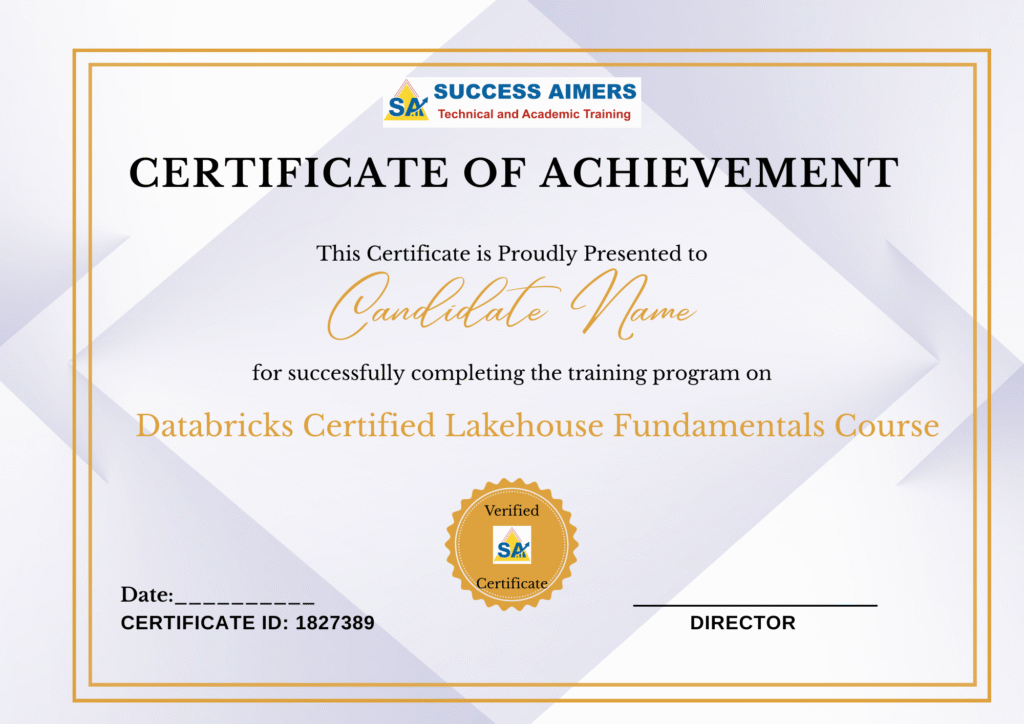
- Get your certificate upon successful completion of the course.
- Certificates for each course
- Azure BLOB Storage
- Azure Synpase
- Azure Databricks
- Azure SQL Server
- Azure Functions
- Azure App Services
- Azure Logic Apps
- Azure Document DB
- Azure Fabric
- Azure Kubernetes Service (AKS)
- Azure Container Registry (ACR)
- DBFS
- Databricks DeltaLake
- Azure Moniter

35% - 50%







Designed to provide guidance on current interview practices, personality development, soft skills enhancement, and HR-related questions

Receive expert assistance from our placement team to craft your resume and optimize your Job Profile. Learn effective strategies to capture the attention of HR professionals and maximize your chances of getting shortlisted.

Engage in mock interview sessions led by our industry experts to receive continuous, detailed feedback along with a customized improvement plan. Our dedicated support will help refine your skills until your desired job in the industry.

Join interactive sessions with industry professionals to understand the key skills companies seek. Practice solving interview question worksheets designed to improve your readiness and boost your chances of success in interviews

Build meaningful relationships with key decision-makers and open doors to exciting job prospects in Product and Service based partner

Your path to job placement starts immediately after you finish the course with guaranteed interview calls
Why should you choose to pursue a Databricks certified Lakehouse Fundamentals Course with Success Aimers?
Success Aimers teaching strategy follow a methodology where in we believe in realtime job scenarios that covers industry use-cases & this will help in building the carrer in the field of Databricks & also delivers training with help of leading industry experts that helps students to confidently answers questions confidently & excel projects as well while working in a real-world
What is the time frame to become competent as a Databricks certified Lakehouse Fundamentals?
To become a successful Databricks certified Lakehouse Fundamentals required 1-2 years of consistent learning with dedicated 3-4 hours on daily basis. But with Success Aimers with the help of leading industry experts & specialized trainers you able to achieve that degree of mastery in 6 months or one year or so and it’s because our curriculum & labs we had formed with hands-on projects.
Will skipping a session prevent me from completing the course?
Missing a live session doesn’t impact your training because we have the live recorded session that’s students can refer later.
What industries lead in Databricks implementation?
- Manufacturing
- Financial Services
- Healthcare
- E-commerce
- Telecommunication
- BFSI (Banking, Finance & Insurance)
- Travel Industry
Does Success Aimers offer corporate training solutions?
At Success Aimers, we have tied up with 500 + Corporate Partners to support their talent development through online training. Our corporate training programme delivers training based on industry use-cases & focused on ever-evolving tech space.
How is the Success Aimers Databricks certified Lakehouse Fundamentals Course reviewed by learners?
Our Databricks certified Lakehouse Fundamentals Course features a well-designed curriculum frameworks focused on delivering training based on industry needs & aligned on ever-changing evolving needs of today’s workforce due to Cloud Computing (Databricks). Also our training curriculum has been reviewed by alumi & praises the thorough content & real along practical use-cases that we covered during the training. Our program helps working professionals to upgrade their skills & help them grow further in their roles…
Can I attend a demo session before I enroll?
Yes, we offer one-to-one discussion before the training and also schedule one demo session to have a gist of trainer teaching style & also the students have questions around training programme placements & job growth after training completion.
What batch size do you consider for the course?
On an average we keep 5-10 students in a batch to have a interactive session & this way trainer can focus on each individual instead of having a large group
Do you offer learning content as part of the program?
Students are provided with training content wherein the trainer share the Code Snippets, PPT Materials along with recordings of all the batches

Databricks Certification Training in Chennai Master Databricks Cloud and get prepared for Databricks official certifications...
Databricks Certification Training in Delhi Master Databricks Cloud and get prepared for Databricks official certifications...
Databricks Certification Training in Faridabad Master Databricks Cloud and get prepared for Databricks official certifications...
Databricks Certification Training in Gurgaon Master Databricks Cloud and get prepared for Databricks official certifications...
Databricks Certification Training in Hyderabad Master Databricks Cloud and get prepared for Databricks official certifications...
Databricks Certification Training in Kolkata Master Databricks Cloud and get prepared for Databricks official certifications...
Databricks Certification Training in Mumbai Master Databricks Cloud and get prepared for Databricks official certifications...
Databricks Certification Training in Noida Master Databricks Cloud and get prepared for Databricks official certifications...
Databricks Certification Training in Pune Master Databricks Cloud and get prepared for Databricks official certifications...
Databricks Data Analyst Certification Training in Chennai Master Databricks Cloud and get prepared for Databricks...
Databricks Data Analyst Certification Training in Delhi Master Databricks Cloud and get prepared for Databricks...
Databricks Data Analyst Certification Training in Faridabad Master Databricks Cloud and get prepared for Databricks...
Databricks Data Analyst Certification Training in Gurgaon Master Databricks Cloud and get prepared for Databricks...
Databricks Data Analyst Certification Training in Hyderabad Master Databricks Cloud and get prepared for Databricks...
Databricks Data Analyst Certification Training in Kolkata Master Databricks Cloud and get prepared for Databricks...