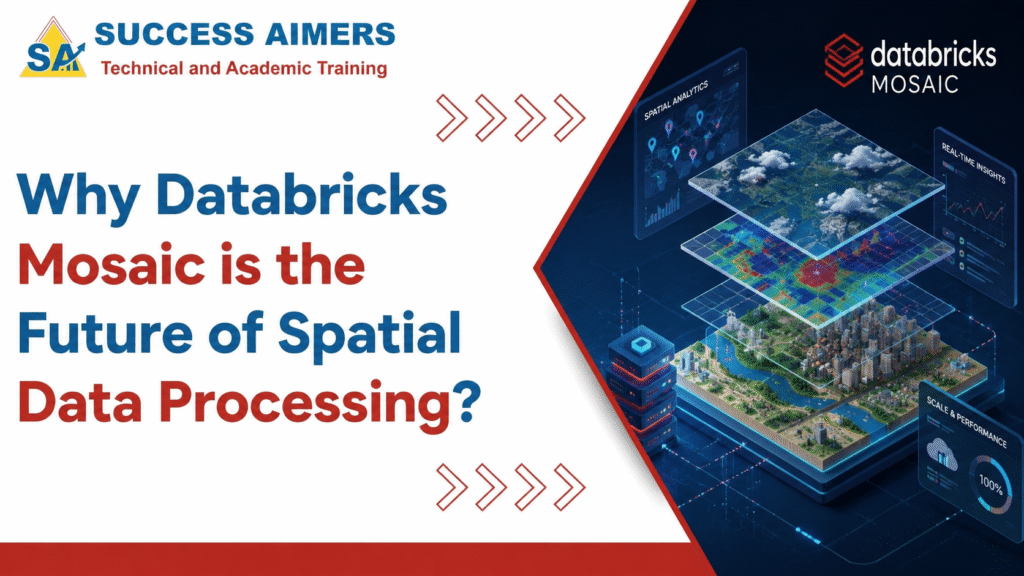
Spatial data is essential in the current data-driven world that creates products and services in the logistics, urban planning, transportation, and retail industries. Companies are becoming more and more dependent on geospatial data in order to make more informed decisions and streamline their operations. Nevertheless, the analysis of high spatial volumes of data has never been an easy task, as it is too complicated and demands performance. This is where Databricks Mosaic comes in as a potent solution, changing the way that spatial data is processed, analyzed, and utilized at scale.
The Growing Importance of Spatial Data in Modern Industries
Spatial information is not confined to things on maps and navigation systems. It has become an indispensable part of business intelligence and decision-making processes in various industries.
Why Spatial Data Matters Today
Spatial data can be used by companies to understand customer behavior, optimize delivery routes, and plan the development of infrastructure. As data volume grows, traditional systems cannot effectively process large volumes of geospatial data.
Important uses of spatial data are the following:
• Location-based customer analytics
• Optimization of routes in logistics.
• Planning of urban areas and infrastructure.
• Environmental and climate analysis.
As big data continues to grow, spatial workload processing tools, such as Databricks Mosaic, are becoming increasingly important.
Challenges in Traditional Spatial Data Processing
It is necessary to determine the shortcomings of the traditional spatial data processing systems before appreciating the advantages of modern tools.
Limitations of Legacy Systems
The common problems with traditional GIS systems are the large datasets, real-time processing, and scalability. Such constraints prevent organizations from deriving as much value as possible out of spatial data.
Common challenges include:
• The processing time for complex queries is long.
• Inability to work with big data platforms.
• There is a lack of real-time data processing functionalities.
These issues demonstrate the necessity of high-performance solutions such as Databricks Mosaic, which is created on the basis of modern data ecosystems.
How Databricks Mosaic Transforms Spatial Data Processing
The modern world needs the tools that are able to process massive datasets while preserving speed and accuracy. This is where Databricks Mosaic comes in.
Built for Big Data and Scalability
Databricks Mosaic is made to be compatible with Apache Spark so that it can process spatial data at scale in a distributed manner. It enables organizations to handle huge amounts of data effectively without affecting performance.
Key capabilities include:
• Processing distributed spatial data.
• Interoperability with the Apache Spark ecosystem.
• High-performance geospatial queries
• Scalability: Enterprise-level data.
Databricks Mosaic allows businesses to realize the potential of spatial data with these features.
Advanced Spatial Analytics with Mosaic
The capability to conduct sophisticated spatial analytics without any problem is one of the largest benefits of using Databricks Mosaic.
Unlocking Deeper Insights
Mosaic also supports indexing and transformations, enabling users to quickly accomplish complex geospatial analysis.
The more sophisticated analytics features are:
• Geospatial indexing to enable quicker queries.
• Coordinate and polygon transformations.
• Can process large spatial datasets effectively.
These features make Databricks Mosaic a preferred option for organizations whose operations rely on insights drawn from data.
Seamless Integration with Modern Data Platforms
Contemporary operations of business are conducted on interdependent systems, and their integration is critical in facilitating effective workflows.
Interoperability with Data Ecosystems.
Databricks Mosaic is an adaptable solution to enterprises, as it can be integrated in multiple ways with all cloud platforms, data lakes, and analytics tools.
Integration benefits include:
• Ability to integrate with cloud-based architectures.
• Easy integration with data lakes.
• Multiple data formats.
• Fluid processing of data pipelines.
Such integration enables Databricks Mosaic to be very flexible in contemporary business settings.
Enhancing Performance and Efficiency
A key consideration when handling large-scale spatial data is performance. Delays and inefficiencies can be caused by slow processing.
Optimized for Speed and Accuracy
Databricks Mosaic is designed to support high-speed processing so that spatial queries can be implemented fast and with high accuracy.
Performance advantages include:
• Faster query execution
• Reduced processing time
• Efficient resource utilization
• Enhanced data processing features.
These advancements make Databricks Mosaic a solution that is ready to meet the requirements of spatial data processing in the future.
Expanding Career Opportunities in Spatial Data Technologies
As the use of spatial data tools increases, there is an increasing demand for professionals with skills in geospatial analytics.
Career Growth in Geospatial Data
Those professionals who are aware of such tools as Databricks Mosaic will have an opportunity to explore the exciting opportunities of data engineering, analytics, and AI-driven solutions.
Career opportunities include:
• Geospatially skilled data engineer.
• Spatial Data Analyst
• Big Data Engineer
• AI and data science positions.
Applications such as Databricks Mosaic have the potential to greatly improve employment opportunities in the field of data.
The Future of Spatial Data Processing
The future of spatial data is scalable, efficient, and intelligent systems capable of managing huge data volumes and delivering real-time information.
Why Mosaic is the Future
Databricks Mosaic is not merely a device; it is a step toward the current, scalable geospatial processing solutions.
Future trends include the following:
• More real-time spatial analytics.
• Integration with AI and machine learning
• Growth of location-based services.
• Increase in smart city and IoT applications.
As these trends keep on evolving, Databricks Mosaic will be instrumental in driving the future of spatial data processing.
Conclusion
Spatial data is emerging as a crucial asset to organizations that want to achieve a competitive edge in the present-day data-driven world. The complexity and the scale of modern geospatial data are beyond the capability of traditional systems. Databricks Mosaic is a scalable, powerful, and efficient solution that helps businesses to process, analyze, and utilize spatial data effectively.Its integration capabilities, high performance, and advanced features of analytics make it obviously the future of spatial data processing. Such higher-level technologies are being taught and learned by learners through institutions such as Success Aimers so that they can develop strong careers in data engineering and analytics.